
When buying office cubicles for small businesses, the first step is to understand why your workplace needs them. Office cubicle Houston create private spaces in the office environment that allow employees to focus and be more productive. These cubicles are especially important in small spaces because they can effectively use limited space and allow each employee to have their own dedicated space.
When purchasing office cubicles for small businesses, consider different types such as panel-based, modular, and height-adjustable systems. Choose based on space, budget, and employee needs. Pay attention to pricing, installation, and after-sales service. Focus on ergonomics, cable management, and acoustic control. Decide between new or used models for cost-effectiveness. Finally, explore reliable vendors and trusted brands to ensure quality and long-term support.
In this guide, you will learn about the steps to buying office cubicles for small businesses, ergonomic tips, a cubicle buying checklist, and a comparison of new and used models.
What is an Office Cubicle?
An office cubicle is a confined, dedicated workspace, usually made of removable partitions, used in office environments to separate different work areas. These cubicles can be installed temporarily or permanently, providing a personal space for each employee while still maintaining the necessary communication with colleagues in the workplace.
Benefits of Office Cubicles
Using office cubicles for businesses has many benefits, as follows:
- Privacy: Providing a private space for each employee helps reduce distractions and increase focus.
- Space division: Cubicles help to properly divide the office space and make better use of limited space.
- Increased productivity: Providing a quiet, distraction-free environment increases employee productivity.
- Customization: Ability to adjust partitions and workspace according to individual and team needs.
- Sound management: Reduces noise and distractions by using high or soundproof partitions.
These benefits make office cubicles a good choice for work environments with limited space and the need for greater concentration.
Types of Office Cubicles for Small Businesses
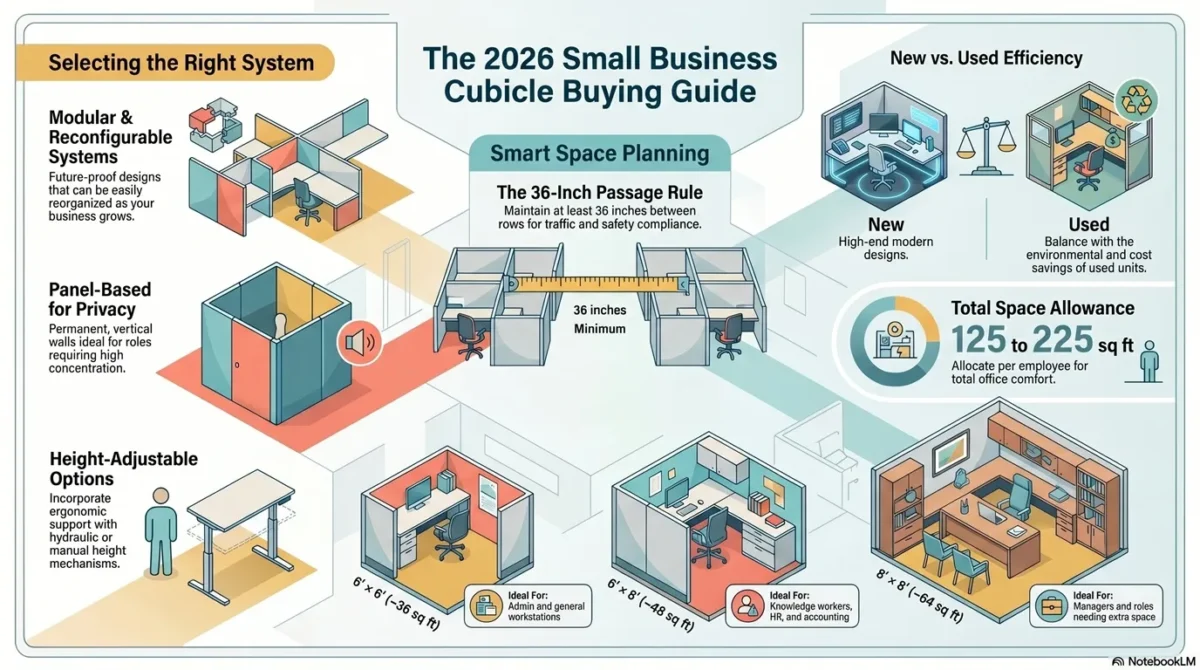
When purchasing office cubicles for small businesses, it is important to choose the right type of cubicles based on the specific needs of the space, the functionality of the space, and the productivity of employees. In this section, the different types of office cubicles are reviewed to help you make the best choice based on your needs.
1. Panel-based Cubicles
Panel-based cubicles are one of the most common types of office cubicles. These types of cubicles consist of vertical walls, which are usually made of various materials such as fabric, metal, or plastic. Panel-based cubicles are usually installed permanently and can have different heights.
Advantages:
- Excellent privacy: The tall walls create a private environment for each employee.
- Compatible with limited space: Due to their vertical structure, these types of cubicles can effectively divide limited space.
- Customization: These cubicles can be easily customized by adding various accessories such as shelves or peripheral devices.
These types of cubicles are usually suitable for offices that require high work characteristics and concentration.
2. Freestanding Cubicles
Freestanding cubicles are independent and portable partitions that are placed without the need for fixed walls or connections to the main office structure. These types of cubicles can be fixed in place using solid bases, but at the same time, they are movable.
Advantages:
- Flexibility: These cubicles can be easily moved and installed in different spaces.
- Adaptability to changing environments: For offices with changing spaces and the need for quick renovation, these types of cubicles are a great option.
- Less expensive: These types of cubicles are usually less expensive than fixed types.
These types of cubicles are suitable for work environments with frequent changes or for small spaces that require different layouts.
3. Modular & Reconfigurable Systems
Modular and reconfigurable cubicles are systems that can be built modularly and repeatedly. These systems are made up of separate parts and components that can be easily moved and reorganized for new needs.
Advantages:
- High customization: These types of cubicles allow the work environment to change based on the needs of each employee or team.
- Future-oriented: These cubicles are great for growing businesses that want to easily change the space.
- Space and cost-saving: These systems can easily meet space needs with rapid changes.
These types of cubicles are suitable for growing businesses and companies with changing teams that need flexibility.
4. Height Adjustable Options
Height-adjustable cubicles allow you to adjust the height of the partitions based on your needs. These cubicles usually use hydraulic or manual mechanisms that allow you to adjust the height of the wall to create more privacy or openness in the space.
Advantages:
- Design flexibility: These cubicles allow you to change the height to adjust the amount of privacy or interaction between employees.
- Ergonomic support: Some of these cubicles have an adjustable desk height that is easy to use.
- Light and sound control: By changing the height, you can optimize natural light or control the sound in the workspace.
These types of cubicles are suitable for small businesses, offices that need to adjust privacy, or small spaces that need to be changed constantly.
5. Collaborative Pods & Benching
Collaborative pods and benching are systems designed for collaboration and interaction between employees. These cubicles are usually more open, allowing employees to communicate more easily. This system is one type of office cubicle for small businesses that can be viewed as an investment.
Advantages:
- More collaborative space: These cubicles allow teams to work in a shared space but with some private boundaries.
- Open space and low cost: Due to their open design and simple structure, these cubicles usually cost less.
- Reduced distractions: By combining open space and shorter partitions, you can help create an environment without too many distractions for collaboration.
These types of cubicles are suitable for creative offices and small teams that need more collaboration and interaction.
6. Desk-Mounted Cubicles
Desk-mounted cubicles are cubicles that are attached directly to a desk. These types of cubicles are usually designed for small or far-flung spaces.
Advantages:
- Space-saving: These types of cubicles effectively divide a limited space without taking up much space.
- Easy to move: Because the cubicles are attached directly to the desk, they are easier to move than other types of cubicles.
These cubicles are suitable for offices with limited space, such as small businesses or offices that need quick changes in layout.
New vs. Used Cubicles: A Comprehensive Comparison
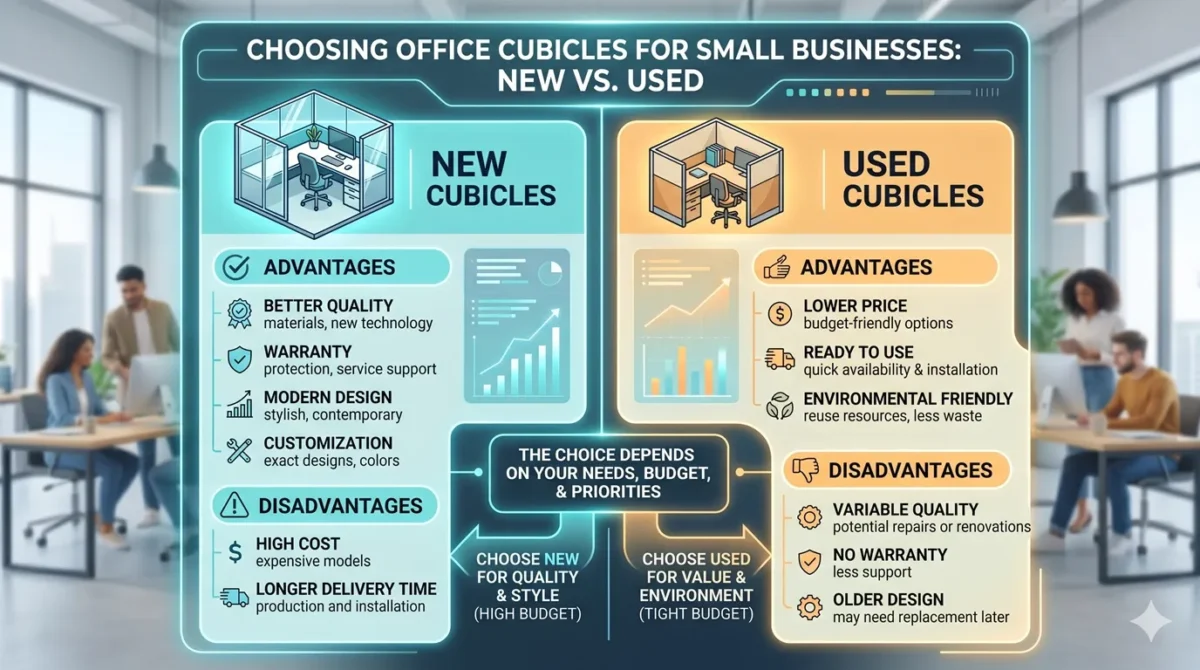
When buying office cubicles for small businesses, one of the most important decisions is choosing between new and used cubicles. Each has its own advantages and disadvantages that can influence your decision.
New Cubicles
Advantages:
- Better quality: New cubicles are usually made with high-quality materials and new technologies.
- Warranty: New cubicles usually come with a warranty that can help you if you have any problems in the future.
- New design: Because they are new, these cubicles usually have more modern and stylish designs.
- More customization: You can order the exact design and color you want.
Disadvantages:
- High cost: New cubicles are usually more expensive than used models.
- Longer delivery time: New cubicles can take longer to deliver and install.
Used Cubicles
Advantages:
- Lower Price: Used cubicles are usually less expensive, which can help you with tight budgets.
- Ready to Use: Many used cubicles are in good condition and can be installed in your office quickly.
- Environmental: Buying used cubicles means reusing resources and reducing waste.
Disadvantages:
- Variable Quality: The quality of used cubicles can vary and may require repairs or renovations.
- No Warranty: Most used cubicles do not come with a warranty.
- Older Design: The design of these cubicles may not be up to date and may need to be replaced or modified in the future.
The choice between new and used cubicles depends on your needs, budget, and priorities. If you have a high budget and are looking for quality and a new design, new cubicles will be a better option. However, small businesses are often on a budget, and used cubicles are a better option. Also, if you are environmentally inclined to buy second-hand products, used cubicles can be an optimal choice.
Office Cubicle Buying Guide Checklist for Small Businesses (2026)
Determine Space Requirements
- Measure total available office space
- Identify areas that require privacy and focus
- Plan for employee movement and accessibility
Choose the Right Cubicle Size
- Standard sizes: 6′×6′, 6′×8′, 8′×8′
- Consider smaller sizes for high-density setups or larger sizes for managerial roles
- Account for space for desks, storage, and movement
Select Materials and Durability
- Choose durable materials like laminate, steel, or fabric
- Prioritize long-lasting options to minimize future replacements
- Ensure easy-to-clean surfaces for maintenance efficiency
Consider Flexibility and Expansion
- Opt for modular cubicles that can be reconfigured
- Ensure future growth needs can be met with minimal disruption
- Plan for potential office layout changes
Evaluate Ergonomics and Comfort
- Look for height-adjustable cubicles for employee comfort
- Choose cubicles that support proper posture and seating
- Ensure acoustic control for a quiet work environment
Storage Options
- Choose cubicles with integrated storage solutions (drawers, shelves, filing cabinets)
- Optimize vertical storage to save space
- Ensure easy access to office supplies without clutter
Customization and Aesthetic Appeal
- Select colors and finishes that align with your company’s brand
- Ensure personalization options like logo branding or specific design features
- Create a workspace that fosters a positive and productive environment
Budget Considerations
- Compare the costs of new vs. used cubicles
- Consider hidden costs like installation and delivery fees
- Factor in long-term maintenance and durability
Vendor and Brand Selection
- Choose reliable vendors with good customer support
- Research well-known brands with warranties and service options
- Check customer reviews for feedback on quality and support
Plan for Installation and Setup
- Ensure professional installation services are available
- Set up cubicles in a way that maximizes employee collaboration and privacy
- Verify that cable management and power outlets are properly integrated
Check for Warranty and Support
- Confirm warranty details and coverage period
- Ensure after-sales support and availability of replacement parts
Environmental Impact
- Consider eco-friendly materials and sustainable sourcing options
- Choose companies with a commitment to environmental responsibility
Cubicle Size, Layout & Office Planning
Office space planning for office cubicles is one of the most important parts of office design, especially for small offices in Houston. Choosing the right cubicle sizes, defining the office cubicle layout, and how to do cubicle space planning have a direct impact on employee productivity, satisfaction, and optimal use of available space.
First of all, you need to measure the entire office space, consider fixed obstacles, and then determine how many workstations you want to have. For space per employee, between 125 and 225 square feet of space is usually considered as a measure of the entire office (including hallways and common areas) to maintain a balance between crowding and comfort.
Standard Cubicle Sizes
In practice, there are a few standard sizes that are suitable for most offices and small businesses in Houston and will help you plan your space better:
| Cubicle Size (L × W) | Square Footage | Ideal For |
| 5′×5′ | ~25 sq ft | Call centers, high-density layouts (Cubicle by Design) |
| 6′×6′ | ~36 sq ft | General office workstations, admin (Cubicle by Design) |
| 6′×8′ | ~48 sq ft | Knowledge workers, HR, accounting (Cubicle by Design) |
| 8′×8′ | ~64 sq ft | Managers, supervisors, and roles needing extra space (Cubicle by Design) |
These sizes are not only documented but are also accepted as standard by many office workstation types, helping you optimize space based on the tasks of each role.
How to Plan Your Office Space and Layout
Measure Accurately: First, determine the total area of the room, then subtract unused space (such as columns, hallways, doors, and windows) to determine the “usable space” for cubicle layouts.
Choose a layout based on your needs:
- Rows: Suitable for large teams that need to work in a focused manner.
- Pods/Clusters: Ideal for collaborative teams and facilitates communication between members.
- Consider Traffic Flow: There should be at least 36 inches of clear passage between rows for movement and ADA compliance in aisles for both ease of access and safety.
Lighting and Communications: Plan to maximize natural light at each station, and plan power and data cabling routes before final layout.
Practical Tips for Small Offices
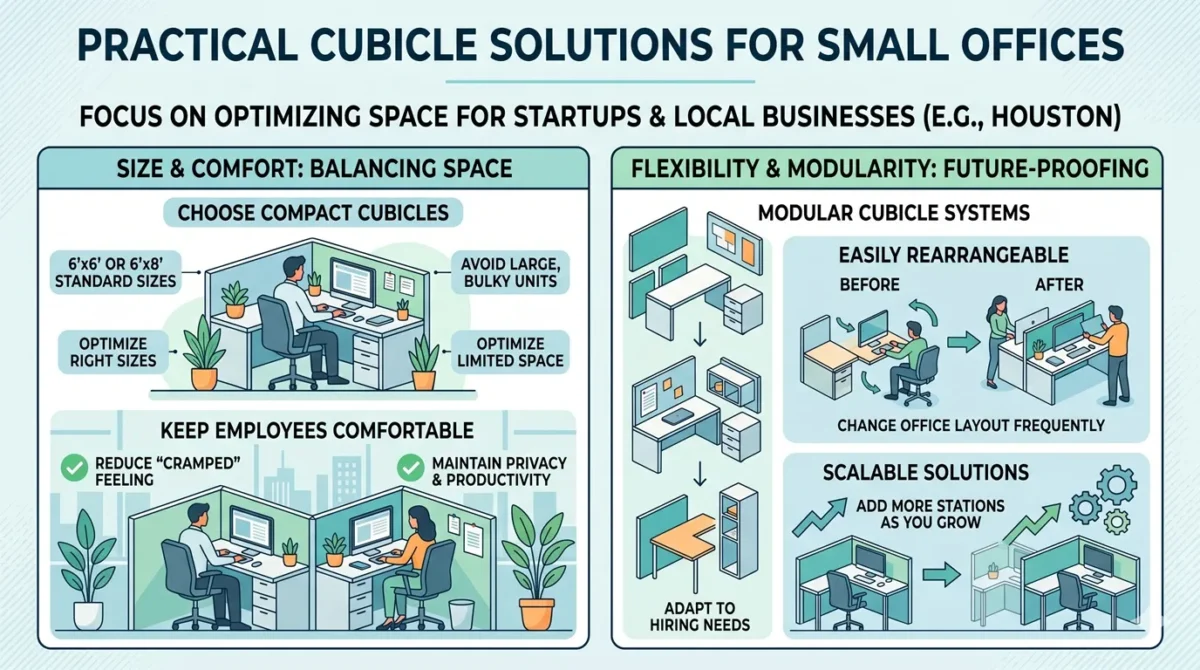
For small businesses — such as startups, local offices in Houston, or companies with a limited number of employees — instead of using large cubicles, focusing on a combination of standard sizes like 6′x6′ or 6′x8′ can help optimize space while also keeping employees from feeling cramped.
Modular cubicles are a great option in this situation, as they can be easily rearranged whenever you need to add more workstations or change the layout.
Conclusion
Buying office cubicles for small businesses requires considering factors such as the right size, quality of materials, ergonomics, storage space, budget, and design flexibility. The right choice can have a huge impact on productivity, employee comfort, and office space optimization. Also, choosing highly durable and customizable cubicles allows you to customize your workspace to your specific business needs. To ensure an informed choice, it is important to seek expert advice from vendors who offer after-sales support and a reliable warranty.
To buy the best office cubicles and receive a free expert consultation from the Wells & Kimich team, one of the most experienced office furniture suppliers in Houston, contact us now and create an optimal space for your business!